Consultinc

I'm a paragraph. Click here to add your own text and edit me.
I'm a paragraph. Click here to add your own text and edit me.
Field Development Planning (FDP)
Conduct studies to evaluate the feasibilities and conceptual field developments (both conventional and unconventional) in various stages: exploration, appraisal, and business development acquisitions
Workflow:
Applied Reservoir Simulation
-
Model construction
-
Model validation based on two approaches:
-
Probabilistic
-
Deterministic
-
-
Designing optimal pressure management strategy
-
Maximizing production subject to complex/dynamic constraints
-
Automate prediction logics
Designing pressure management strategy and pore pressure drilling limits including short-term manual curtailment, long-term region pressure control (RPC), voidage replacement ratio (VRR), and fill-up removal ratio (FRR)
Maximizing production subject to complex constraints such as managing reservoir pressure for safely drilling of future wells and dynamic PSAT’s (saturation pressure) based on automatic well logic.
Setting up prediction logics to fully automate future well activities including recompletion, sidetrack, sliding sleeve, functioning DHFC (down hole flow control for smart wells), switching between single or commingle production and optimal wells assignment between flowlines for load balancing and minimizing the system backpressure.
Data Interpretation & Analysis
-
RFT (repeat formation tester)
-
MDT (modular dynamic tester)
-
DST (drill stem test)
-
PTA (pressure transient analysis)
-
RTA (rate transient analysis)
-
TTA (temperature transient analysis)
-
PVT (fluid phase behavior)
-
RCA (routine core analysis )
-
SCAL (scpecial core analysis)
-
Excess pressure
-
Pressure gradient
-
Fluid contact
-
Well integrity/mechanical issues
-
Reservoir connected energy (proximal/medial/distal)
-
Field-wise connectivity and compartmentalization
-
Total Compressibility from extracted tidal and astronomical data
-
Fluid movement and water breakthrough timing
Services
LATEST REPORT

I'm a paragraph. Click here to add your own text and edit me.

I'm a paragraph. Click here to add your own text and edit me.

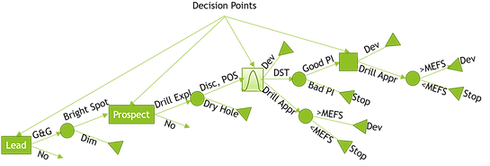
Decision Support Analysis - Exploration & Appraisal
Making the right choices: Choices can conveniently be updated for:
-
Perform G&G study?
-
Drill exploration well?
-
Drill appraisal well?
-
DST?
-
Develop?
Uncertainty Analysis
Probabilistic approach for the assessment of petroleum resource and reservoir performance using two leading methodologies:
-
Experimental Design (DoE)
-
Top-Down Modeling (TDM)
Although Experimental Design or Design of Experiment (DoE) has been proven to be the most popular technique to date and has become the method of choice of many clients for uncertainty analysis, we recommend alternative method, Top-Down Modeling (TDM) for several compelling reasons:
-
Changes in costs of study, test, service, and drilling
-
Changes in economic parameters and criteria
-
New interpretation of seismic and petroleum system
-
Changes in Basin analysis
DoE
Disadvantages:
-
Time consuming - Construct a relatively large set of discrete reservoir models to set up Proxy equations.
-
Inaccuracy - Use of Proxy model as a substitute for full-physics reservoir simulation.
-
Semi probabilistic approach - For overall field performance prediction with multiple reservoirs, the method resemble a multi-scenario or multi-deterministic methodology, it is no longer a fully probabilistic assessment.
TDM
Advantages over DoE:
-
Time saving – Construct a reference reservoir model based on TDM framework
-
Accuracy – Use full-physics reservoir simulation instead of a Proxy
-
Fully probabilistic approach – Monte Carlo simulation is applied to the integrated model combining all reservoirs.
-
A framework to aid for better understanding of uncertainties
-
A highly automated workflow, but flexible for specific customized study
-
Capability to integrate subsurface, operational, and economical uncertainties
-
Considerable time and cost savings compared to the DoE method.
Unstructured Coarsening
An innovative unstructured coarsening technology (not yet available in the industry) was developed, successfully tested and applied in a number of offshore deep-water fields. This technique enables engineers to upscale fine grid geological models with hundreds of millions of grid cells and thousands of layers, to a few-hundred-thousand-cell dynamic model whose resolution is more compatible with the flow simulator.
This tool can speedup almost any existing simulation model by many folds without the sacrifices of model simplification, or excessive IT overhead while still maintaining geological details.